
Checking Criminal History in Montgomery County
No single database contains every Montgomery County criminal record. Begin with the event and the result needed. The Montgomery Circuit Court Clerk holds District and Circuit files at the county courthouse. The arresting agency holds its own report, the regional jail holds the booking, and the Kentucky Court of Justice Administrative Office of the Courts, or AOC, produces statewide CourtNet reports. Kentucky State Police, known as KSP, maintains fingerprint-linked criminal history. Each source answers a different part of the question.
Gather the full legal name, former names or spelling variants, date of birth, approximate event date, and a case or report number when available. Use that data carefully because a name match is not an identity match. A complete self-review often requires both a local file and a statewide report. For deeper treatment of filed charges and judgments, use the Montgomery County criminal court case search.
- Ask the clerk for a known District or Circuit case, including its docket sheet and final order.
- Order an AOCFastCheck report when the search must cover Kentucky court activity beyond Montgomery County.
- Call the jail for current local custody, or use KOOL for later state custody and supervision.
- Request the incident or arrest report from MCSO, Mount Sterling Police, or KSP, whichever created it.
- Compare the charge, amendment, disposition, and sentence before relying on the result.
FastCheck and Montgomery County Records
AOCFastCheck guidance explains the registered online service and the mailed One-Time Request. FastCheck draws from CourtNet across all 120 Kentucky counties. It covers traffic and misdemeanor case types for at least five years and felony case types back to 1978, subject to the stated exclusions. Juvenile, mental-health, domestic-violence, purged, and expunged matters do not appear in the public report.
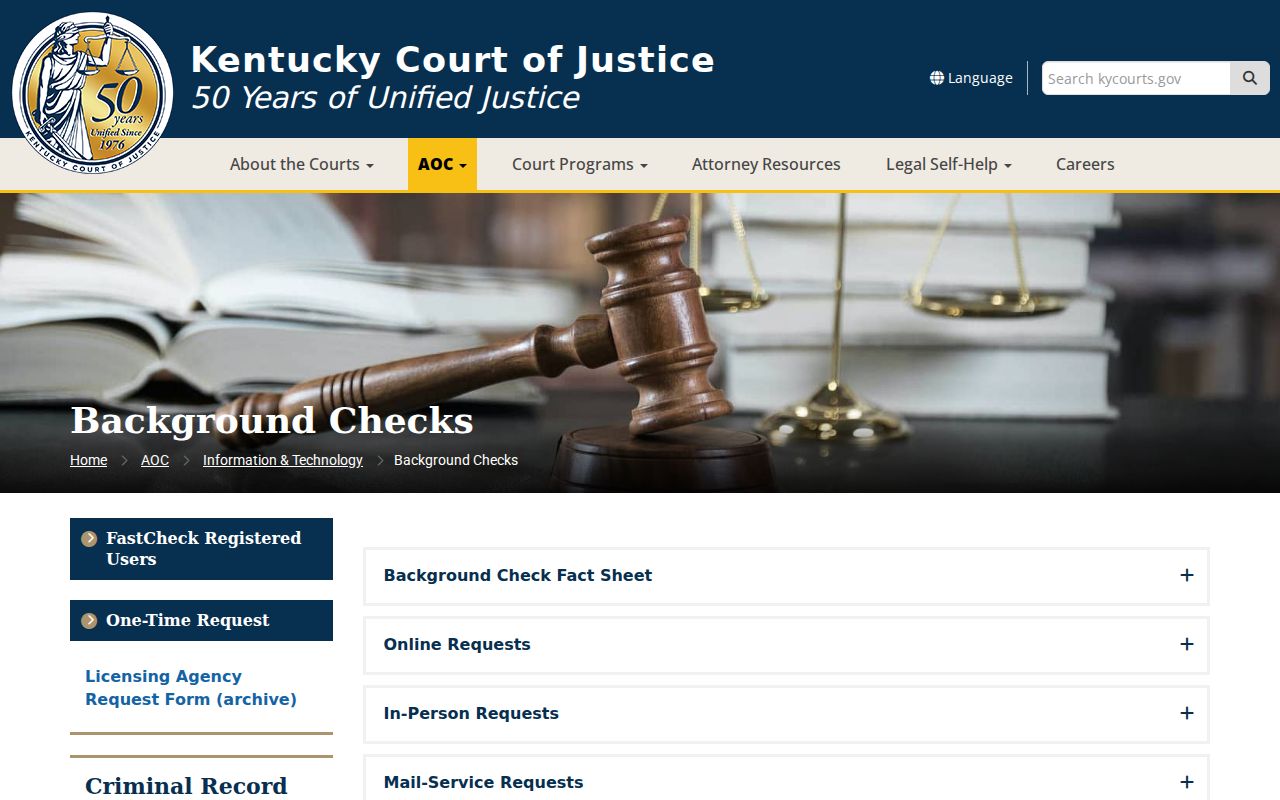
The captured AOC page helps a Montgomery County searcher distinguish statewide summary access from the actual clerk file. Every FastCheck result is marked “Not an Official Court Record.” If a report on another person returns a record, AOC notifies the subject and sends that person a copy. A no-result response can reflect a name mismatch, an excluded case type, a federal or out-of-state case, an entry delay, or a lawful expungement.
| Order field | What to provide | Why it matters |
|---|---|---|
| Requester account or email | Verified contact for the registered path | Online results remain available for 30 days |
| Subject name | Full legal name and offered identifiers | Reduces common-name mismatches |
| Date of birth | Use the format shown at order time | Helps narrow the CourtNet search |
| Request type | Registered FastCheck or mailed One-Time Request | Controls delivery method |
| Payment | Accepted card for an online order | Confirm the current fee at checkout |
Kentucky Official Background Checks
Kentucky has three official lanes with different levels of identification. A Montgomery County clerk file is the strongest source for one local case. AOCFastCheck is a name-based statewide court-history report. KSP fingerprint channels connect qualifying repository data to biometric identity rather than a common name. The FBI Identity History Summary is available to the subject or a properly authorized representative and requires fingerprints.
The FBI electronic request begins through the Identity History Summary portal. Its federal fee is $18, and fingerprints must be submitted with the order reference. No official source confirmed a public Montgomery County fingerprint site with current hours and price. Call KSP Post 8 or the sheriff before traveling. The ordinary public court report should not be described as a fingerprint rap sheet.
| Official source | Coverage | Identification |
|---|---|---|
| Montgomery Circuit Court Clerk | One local District or Circuit case | Name and case number |
| AOCFastCheck | Public Kentucky CourtNet case types | Name and order-form identifiers |
| KSP criminal history | Qualifying Kentucky repository entries | Fingerprints |
| FBI Identity History Summary | Fingerprint submissions held by the FBI | Fingerprints |
Montgomery County Criminal Record Custodians
The office that created a record is usually the right first stop. Montgomery County Sheriff’s Office keeps its reports. Mount Sterling Police Department records go through the city’s custodian. KSP answers for KSP-created reports. The regional jail controls booking and local custody data. Filed complaints, indictments, dockets, judgments, and certified court copies remain with the circuit clerk. Sending the same broad request to every office wastes time and can yield several correct but different answers.
The Montgomery County Sheriff’s Office website identifies the county agency and its services. Its published contact pages do not provide a separately named records division, a report-copy fee schedule, or a formal local record-check form.

The screenshot supplies a first-party starting point, while a focused written Kentucky Open Records Act request remains the fallback for releasable sheriff records. Describe the incident number, date, place, agency, and exact record sought. Ask for an electronic copy and cost estimate when practical.
Montgomery Court Clerk
1 Court Street
Mount Sterling, KY 40353
Weekdays, 8 a.m. to 4 p.m.
Regional Jail
751 Chenault Lane
Mount Sterling, KY 40353
(859) 498-8747
Mount Sterling City Hall
33 North Maysville Street
Mount Sterling, KY 40353
(859) 498-8725
Criminal Record Types
A criminal-history search can touch many record series. An incident report describes what an officer recorded. A booking entry reflects intake allegations and custody. A complaint or indictment states what was filed in court. A docket and judgment show how that case moved and ended. KSP repository data may link fingerprinted arrest cycles to reported outcomes, while corrections and registry systems publish narrower status information.
Montgomery County records should be read in sequence. An early charge can be amended, rejected, dismissed, or resolved under a different statute. The last visible jail entry is not a court disposition, and a statewide summary is not a signed judgment.
- Police report: the creating agency’s narrative, event data, alleged offenses, and evidence references.
- Booking record: jail intake, fingerprints, booking time, charges, custody, bond, and holds.
- Court file: complaint or indictment, motions, pleas, orders, disposition, and sentence.
- Repository history: fingerprint-linked arrest and disposition data reported to KSP or FBI.
- Supervision or registry record: selected public status data from DOC or KSP SOR.
Montgomery County Jail and Custody Records
The Montgomery County Regional Jail is the immediate first-party source for a new booking. No verified public county roster was found, so the safe path is to call with the person’s full name and approximate age or date of birth. Ask for a current booking number and whether the person is held, released, or transferred. Kentucky VINE adds custody status and notification. It does not replace the underlying booking file.
KOOL serves a later stage. The Kentucky Online Offender Lookup shows selected state incarceration and community-supervision data after DOC assumes custody or supervision. A recent pretrial detainee may not appear. The federal BOP locator covers federal prisoners only. None of these empty search results proves that no Montgomery County arrest occurred.
Official weekly DOC reports list 134 rated beds at the regional jail. One report counted 188 people on November 6, 2025, and another counted 208 on March 13, 2025. Those are dated custody snapshots, not a live roster or a crime rate. Local detention can include pretrial detainees, local sentences, state classifications, holds, and people awaiting transport.
Inside a Montgomery County Criminal Record
Read each field in context and compare it with the source. Public records may show a legal name, aliases, birth data, arresting agency, arrest date, statute, case number, disposition, sentence, and custody or supervision events. Social Security numbers, financial accounts, juvenile and victim-sensitive data, sealed material, and some investigative details are normally restricted or redacted.
One person can have an “F” District Court felony matter and a related “CR” Circuit Criminal case after indictment. “M” marks misdemeanor case families and “T” marks traffic. Ask the clerk for the final judgment or dismissal order instead of treating the last docket line as the result.
| Name and identifiers | Legal name, aliases, birth details, and repository or fingerprint control numbers where lawfully shown |
|---|---|
| Arrest and booking data | Agency, time, place, intake charge, booking reference, custody, bond, or hold |
| Charges and statutes | Original allegation, filed charge, amendments, and cited Kentucky law |
| Disposition | Dismissal, acquittal, plea, conviction, or other final charge outcome |
| Sentence | Confinement, probation, restitution, fines, or other terms in the court order |
| Custody or supervision | Selected jail, prison, probation, parole, release, or abscond status |
Montgomery County Arrest-to-Court Records
A Montgomery County event can create three histories. Police document the incident and arrest. The jail creates a separate booking. Prosecutors and courts then create the filed case. Fingerprint-supported arrest data may reach KSP, while the clerk’s reported disposition updates CourtNet. Delays, amended charges, sealed files, missing fingerprints, and cases filed elsewhere can make these systems differ without any one screen telling the whole story.
Record flow: Incident or arrest → Regional jail booking → District complaint → Circuit indictment when returned → Plea or trial → Judgment and sentence → Reported disposition.
The original arrest charge is an allegation. A prosecutor may change it, and a grand jury may decline or return an indictment. The filed disposition controls the legal outcome. The separate Montgomery County arrest lookup explains every verified local custody and report channel.
- Arraignment
- The hearing where charges are formally presented and a plea is taken.
- Disposition
- The final outcome of a charge or case.
- Indictment
- A grand jury’s formal felony accusation.
- Docket
- The chronological record of events entered in the court file.
Public Access Laws in Kentucky
The Kentucky Open Records Act gives Kentucky residents a route to inspect executive-branch public records, subject to exceptions. A request should identify an existing record rather than ask an agency to research a question or create an analysis. Montgomery County law-enforcement files may be redacted or withheld when privacy, victim, juvenile, active-investigation, or other statutory limits apply. Court files follow judicial administration and should be requested from the local clerk.
A denial should cite the legal basis and explain it well enough for review. The correct custodian still matters: city reports go to the city, sheriff reports to MCSO, KSP reports to KSP, bookings to the jail, filed cases to the clerk, and statewide CourtNet reports to AOC.
Key Kentucky laws:
KRS 61.872 provides the written public-record inspection route, subject to statutory requirements.
KRS 61.878 lists privacy, law-enforcement, and other exemptions that may support redaction or withholding.
KRS 17.150 governs inspection of specified law-enforcement records and explanations for withholding.
KRS 431.073 sets conditions for vacating and expunging qualifying felony convictions.
KRS 17.510 through 17.580 govern sex-offender registration, public data, duties, and misuse.
Montgomery County Warrant and Supervision Records
No verified public Montgomery County active-warrant database was located. Call MCSO for its warrant or court-services contact, and ask the clerk about a capias or bench warrant in a known case. A written request may reach releasable records, but an active, sealed, juvenile, or investigative warrant can remain unavailable. Staff cannot promise that a caller will not be arrested. Counsel can help arrange a safe response to an outstanding warrant.
Probation and parole are also split across systems. Kentucky DOC’s Division of Probation and Parole runs state field supervision, while the sentencing court retains the order and any violation or revocation filing. KOOL may show status, county of supervision, offenses, dates, and abscond information. “Absconded” describes a supervision status, not a new conviction by itself.
The Kentucky probation and parole page identifies the state supervision structure used for qualifying Montgomery County cases.
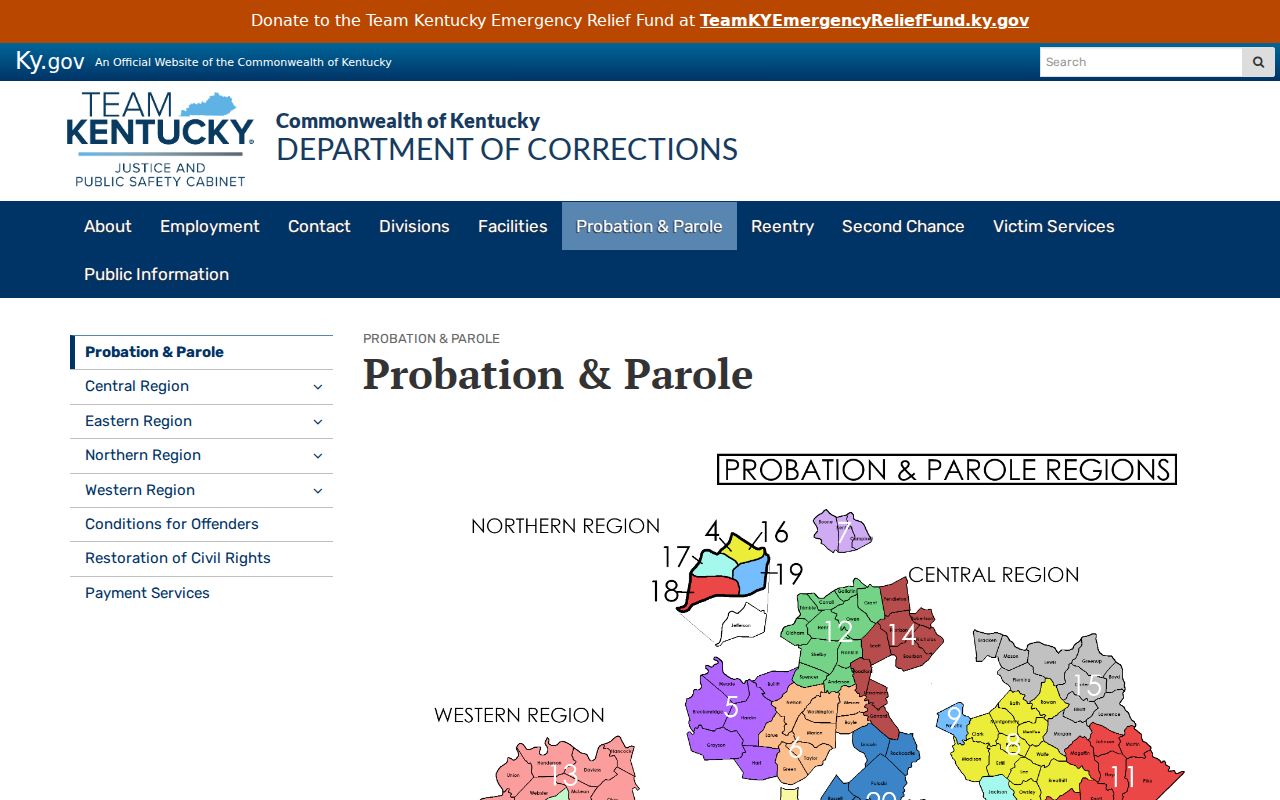
The captured state page is a routing source. Detailed conditions, officer notes, treatment information, medical data, and risk assessments should not be assumed public.
Correcting Montgomery County Criminal Records
Start a correction with the source of the disputed fact. If the Montgomery County judgment is right but a CourtNet summary is wrong, ask the clerk to verify the local entry, then contact the AOC Records Unit at (800) 928-6381. If a booking file still shows an old charge, provide the jail or arresting agency with the later court order. A fingerprint-history dispute may also require KSP or FBI review.
Keep the report, request confirmation, certified judgment, and any expungement order together. Compare dates and case numbers before claiming an error because an original charge and an amended charge can both be accurate at different points. A later order may also correct an earlier docket entry. Each custodian can change only the system it controls, so one successful correction does not guarantee that every connected Montgomery County record has updated.
Sealed, Expunged, and Restricted Records
Kentucky restricts juvenile cases, mental-health cases, listed domestic-violence case types, victim-sensitive information, personal identifiers, and sealed or expunged files. AOC public reports omit confidential and purged matters. Courts, prosecutors, law enforcement, or another entity expressly authorized by law may retain limited access even when an ordinary public search no longer displays the case.
Montgomery County applicants first request a $40 expungement certification from AOC and KSP. Online statuses include Pay Now, Processing, Sent to KSP, and Complete. The completed certification and correct AOC form then go to the Montgomery Circuit Court Clerk where the original charge was filed. Eligible felony applications use AOC-496.3, while misdemeanor, violation, or traffic conviction applications use AOC-496.2. The AOC-497 series serves qualifying acquittal, dismissal, and failure-to-indict relief.
The Kentucky Court of Justice expungement page publishes the certification workflow, official forms, and current fee structure.
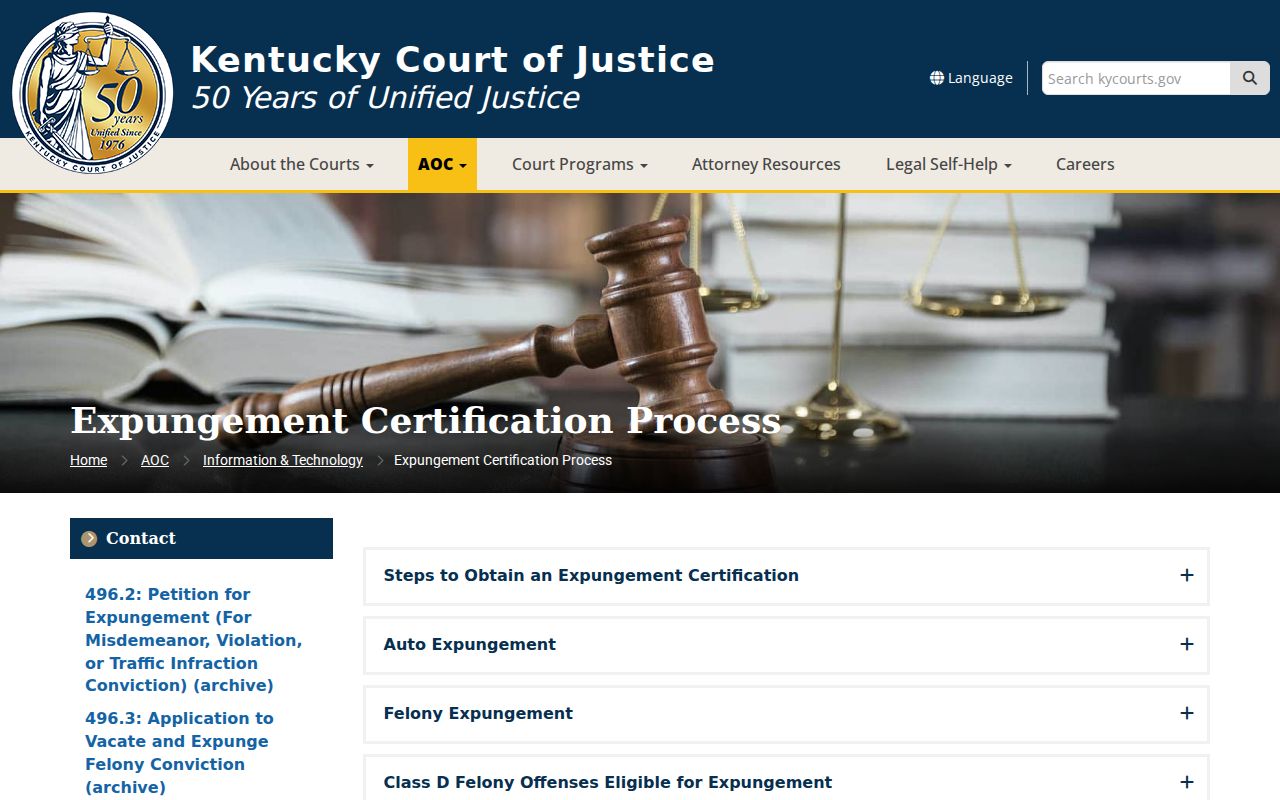
The image reinforces a key sequence: obtain certification before filing the local petition. Qualifying cases dismissed with prejudice or acquitted on or after July 15, 2020 are automatically expunged after 30 days, excluding traffic cases. If an old record remains, obtain a certified order and contact the clerk and each reporting agency.
Montgomery County Criminal Records by City
Montgomery County has three incorporated cities, but only Mount Sterling has a separately verified municipal police department. All three use the county’s unified District and Circuit courts rather than separate city criminal courts. City guides therefore focus on the actual local route. Mount Sterling police reports go through the city custodian; Jeffersonville and Camargo users must identify whether MCSO or KSP made the record. Bookings move to the regional jail, and filed cases move to the clerk in Mount Sterling.
These city routes prevent a common error: an incident’s location does not prove which government owns its report. The three card links match the city lists in the rail and footer.
Mount Sterling Criminal Records
Population 7,558. MSPD reports use the city custodian; county courts hold filed cases.
Jeffersonville Criminal Records
Population 1,708. Identify MCSO or KSP before requesting a law-enforcement report.
Camargo Criminal Records
Population 1,020. County and state channels replace a separate city police portal.
Montgomery County Criminal Record Geography
Montgomery County’s justice offices are concentrated in Mount Sterling. The courthouse and clerk sit on Court Street, City Hall is on North Maysville Street, and the regional jail is on Chenault Lane. A Jeffersonville or Camargo incident can start miles from the county seat and still create a booking and court file in Mount Sterling. Physical proximity does not merge the records. A sheriff report, city report, jail booking, and clerk disposition remain separate.
Census QuickFacts for Montgomery County provides official population context for the local system.
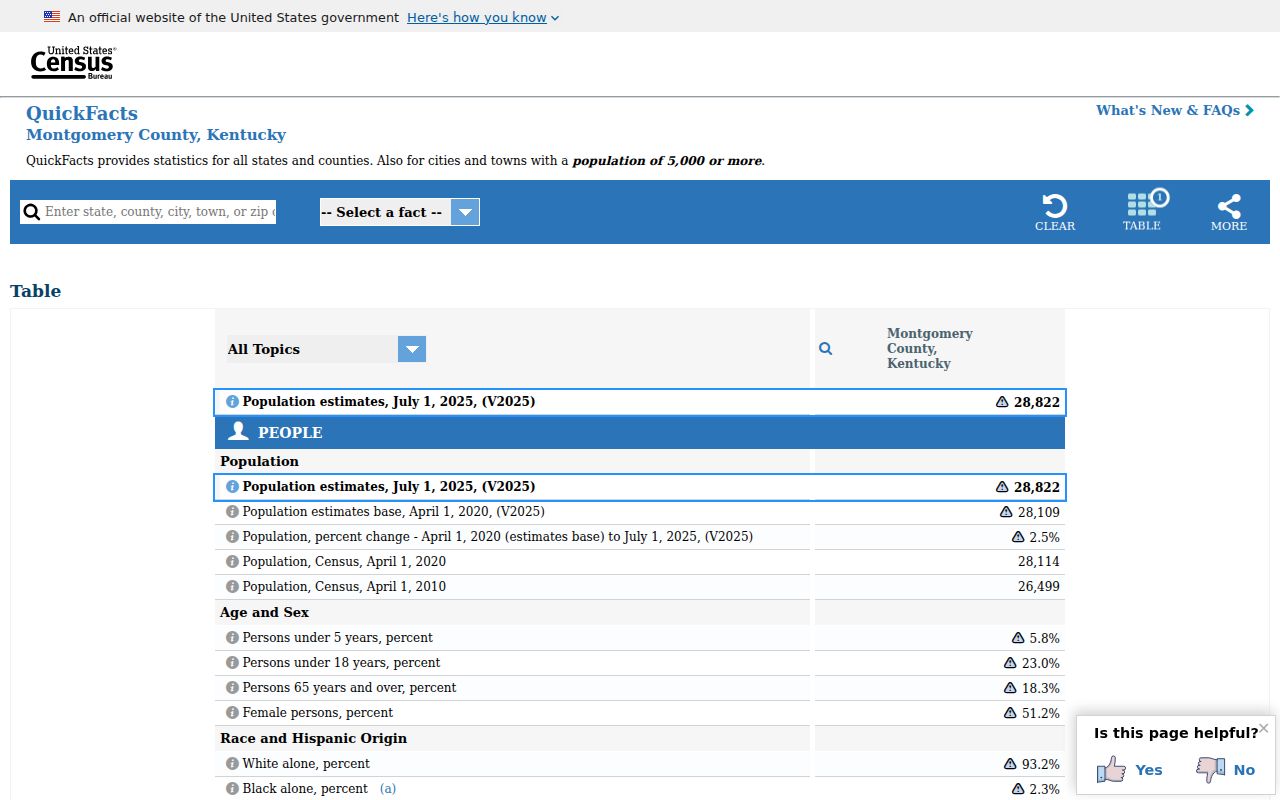
The official source reports 28,114 residents at the 2020 Census and a July 1, 2025 estimate of 28,822. Those figures explain the county scale but do not measure crime, arrests, or court filings. No current stable county crime table was found in the research, so population and jail snapshots should never be turned into an unsupported crime-rate claim.
For a clean search, follow the record rather than the map: creator for the report, jail for the booking, clerk for the case, AOC for the statewide court summary, and KSP or FBI when fingerprint-supported history is needed.